Brigade Stellaris in Chennai: RERA Details, Cost & Structure

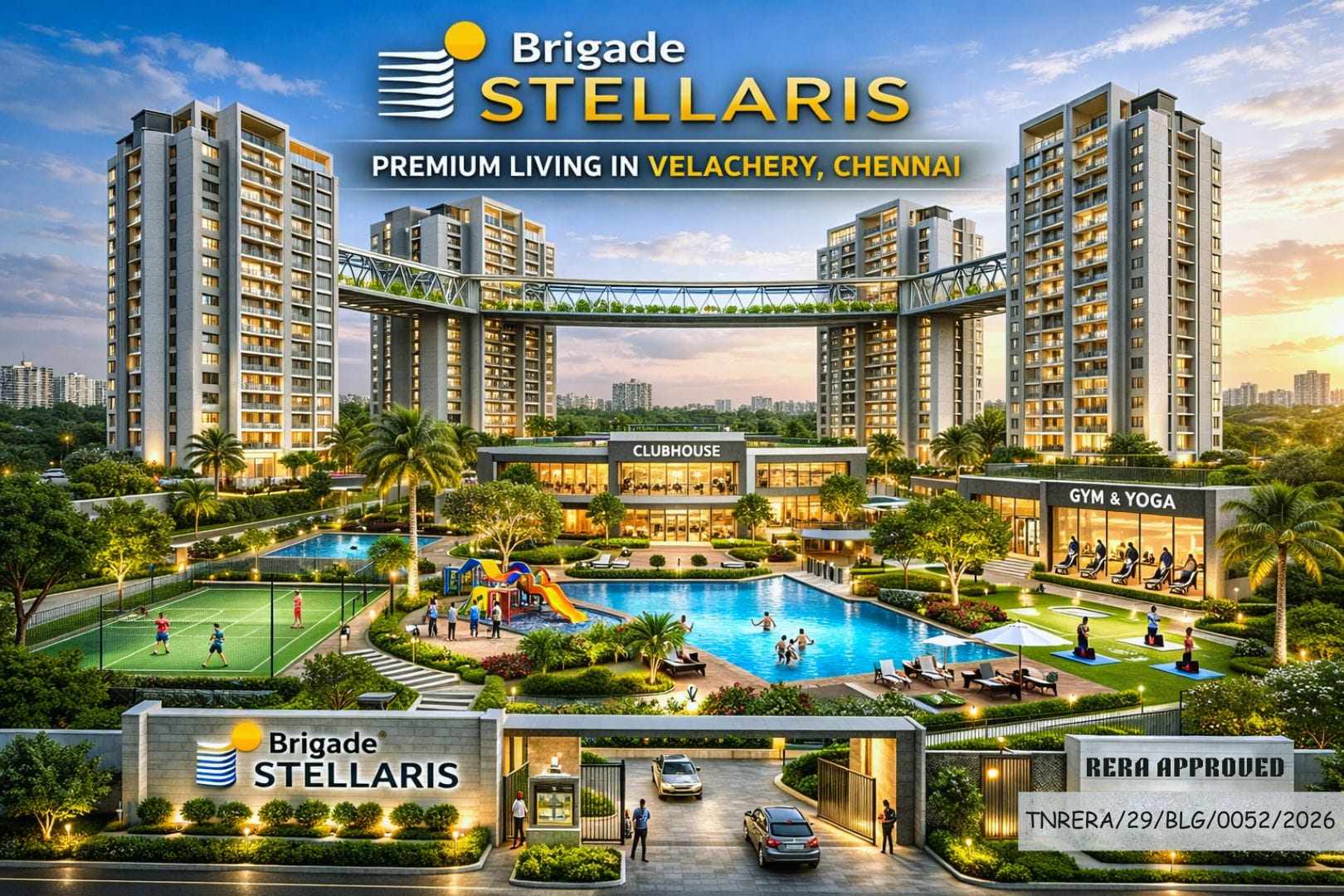
Architecture defines identity through more than just the height of a building. Meaningful urban projects find their form through intention and clear structure. The way a development situates itself within the city also matters. Brigade Stellaris at Velachery in Chennai presents itself as a high-rise mixed-use development. The deeper value of this project lies in how these elements come together as a coherent urban proposition.
Potential buyers must look beyond brochures to understand the core identity of the property. This process requires a close look at the structural and spatial framework. The regulatory framework also provides essential details for a clear evaluation. People gain confidence when they study these fundamental aspects of a home.
1. A High-Rise with Measured Intent
Brigade Stellaris Chennai is registered under RERA No. TNRERA/29/BLG/0052/2026 and classified as a High Rise Building (HRB). The designation is not merely technical. The evolving skyline of Chennai features high-rise buildings that require strict compliance, advanced engineering, and coordinated planning of infrastructure.
This development stands on a site area of 21,005 square metres along Velachery Main Road. The scale is significant yet controlled. Instead of overwhelming density, the plan distributes 284 residential units across four towers. Each tower follows a configuration of:
- 2nd Floor
- 13 Typical Floors
- Part 14th Floor
This consistent vertical rhythm across towers establishes architectural order. It avoids fragmentation while allowing each block to function independently.
The identity of Brigade Velachery Chennai, therefore, is not of speculative vertical growth, but of structured vertical living.
2. Mixed Development as Urban Strategy
The project is categorized as Mixed Development. This is a critical point for buyers who are evaluating long-term livability.
The total FSI distribution shows:
- 72,964.40 sq.m allocated to residential use
- 1,547.06 sq.m allocated to commercial use (clubhouse component)
Rather than retail-heavy integration, the commercial component appears focused on lifestyle infrastructure within the development itself. This signals that the project identity is residential-first, supported by amenity-driven commercial planning rather than retail monetization.
In high-demand corridors like Velachery, this distinction matters. A residential-led mixed development typically ensures:
- Controlled internal footfall
- Better privacy for residents
- Clear zoning between public and private spaces
The project does not dilute its residential character.
3. Four Towers, Four Micro-Communities
The distribution of units across towers reveals subtle differentiation:
- Tower 1 – 66 units
- Tower 2 – 68 units
- Tower 3 – 82 units
- Tower 4 – 68 units
Tower 3, with 82 units, carries slightly higher density. This may indicate varied unit configurations or larger floor plates. The identity of Brigade Stellaris thus becomes multi-layered. It is one project, but internally segmented into smaller residential clusters.
Each tower integrates special amenities on the 2nd floor:
- SPA & Business Centre
- Yoga & Indoor Games
- Kids Play Area & Laundry
- Gym, Association Room, Changing Rooms
Distributed amenities across towers encourage decentralized community formation. The management avoids centralizing all facilities in a single clubhouse building. Residents experience the development as interconnected living environments rather than a singular monolithic block.
This architectural decentralization aligns with contemporary residential planning. Social spaces remain accessible within each vertical community under this model. People find it easier to interact with neighbors in these smaller hubs.
4. The Steel Bridge at 46.40 Metres: Symbol and Connector
One defining structural feature of Brigade Velachery Chennai is the steel bridge connecting towers at the 14th floor, approximately 46.40 metres above ground level.
This element does more than connect structures physically. It performs three conceptual roles:
- Structural coherence
- Visual identity
- Elevated interaction space
A bridge at this height introduces architectural drama without resorting to excessive ornamentation. It becomes a signature marker in the skyline.
For buyers, this indicates advanced engineering coordination and careful compliance with High Rise Building norms. Steel bridge integration requires structural precision and regulatory clarity, especially under CMDA approvals.
Such a feature reinforces that Brigade Stellaris is designed as a unified architectural composition, not four isolated blocks.
5. Regulatory Clarity and Institutional Approval
In real estate decision-making, project identity is inseparable from its approval framework.
This Brigade project at Velachery, Chennai has received planning approval from CMDA, with documented permission numbers and validity extending to January 2034. This extended validity window indicates administrative preparedness for long-term execution.
For a project currently marked as “Not Yet Started” with completion scheduled for 31 December 2030, this timeline provides buyers with clarity on:
- Regulatory compliance
- Execution horizon
- Planning stability
RERA registration further strengthens the formal identity of the project. It shifts the conversation from marketing claims to documented commitments.
6. Infrastructure Capacity as Identity Marker
A high-rise residential project cannot function without parallel infrastructure depth. The parking provision is particularly telling:
- 655 covered car parks
- 69 visitor car parks
For 284 units, this suggests an allocation well beyond minimal compliance. Such parking capacity reflects anticipation of multi-car households and visitor frequency in an urban residential context like Velachery.
Basement and common floor details indicate additional infrastructure planning:
- Extended 1st Basement: Parking, Fire Pump Room, STP, OWC
- 2nd Basement: Parking and STP Pump Room
- Stilt Floor: Parking
- Ground Floor: Lobby, Badminton Court, Pickleball, Association areas
- 1st Floor: Parking, Swimming Pool Pump Room, Lobby
The layering of basements and utility spaces demonstrates that the design is service-aware. Waste management (OWC), sewage treatment (STP), and fire systems are embedded into the structure, not appended later.
The core identity here is infrastructural robustness.
7. Cost Structure as Reflection of Commitment
The total project cost stands at ₹10,549,257,354. The breakdown shows:
- Land Cost: ₹4,417,000,000
- Construction Cost: ₹6,132,257,354
The construction component surpasses land cost, which suggests significant investment in built quality and structural systems rather than land banking alone.
In many urban projects, disproportionate land valuation skews budgets. Here, the construction allocation signals attention to execution quality, especially for a High Rise Building requiring enhanced safety systems, structural design, and compliance.
8. Velachery as Contextual Anchor
Brigade Velachery Chennai derives its locational identity from Velachery Main Road. This corridor is not just a side route. It forms a core part of the story of growth in South Chennai.
Velachery’s appeal lies in:
- Proximity to IT corridors
- Retail ecosystems
- Established residential clusters
- Road connectivity
The project does not attempt to create isolation. Instead, it positions itself within an already active urban fabric. This is important for buyers who prioritize:
- Immediate neighbourhood maturity
- Reduced waiting time for area development
- Stable property appreciation trends
The core identity of Brigade Stellaris, therefore, is not speculative suburban expansion but embedded urban presence.
9. Scale Without Excess
At 284 units across 21,005 sq.m, the density is measured. There are no sub-60 sq.m units listed. All residential allocation falls under the category of units above 60 sq.m.
This implicitly suggests a mid to premium residential positioning. The absence of small-format LIG units further clarifies the intended buyer segment.
Brigade Stellaris Chennai appears designed for families seeking:
- Larger living spaces
- Long-term occupancy
- Structured community environment
The project does not aim for high-turnover investor-driven micro-units. Its identity leans toward stable end-user ownership.
10. Timeline as Trust Indicator
Completion is projected for 31 December 2030. In urban development cycles, a defined five to six year horizon for a high-rise of this scale is realistic.
For potential buyers evaluating pre-launch or early-stage opportunities, clarity of timeline combined with CMDA approval and RERA registration reduces uncertainty.
The phrase “Not Yet Started” should not be misinterpreted as delay. Instead, in regulated development cycles, it often indicates structured staging aligned with approvals and financing.
Concluding Reflection: What Defines Brigade Stellaris?
The core project identity of Brigade Stellaris at Velachery, Chennai, can be summarized through five defining principles:
- Structured High-Rise Planning
- Residential-First Mixed Development
- Distributed Amenity Ecosystem
- Engineering-Led Signature Element (Steel Bridge)
- Regulatory and Infrastructure Depth
This is not a project built around spectacle. It is built around coordination. Its identity emerges from proportion, compliance, and systemic planning rather than isolated architectural gestures.
For buyers curious about its essence, the question is not simply about square footage or floor plans. It is about whether the project demonstrates internal coherence.
The data shows that Brigade Velachery Chennai is a vertical neighborhood. A steel bridge at 46.40 metres connects the towers, while a single planning logic joins the land, infrastructure, and community together.
That coherence is what ultimately defines its identity.